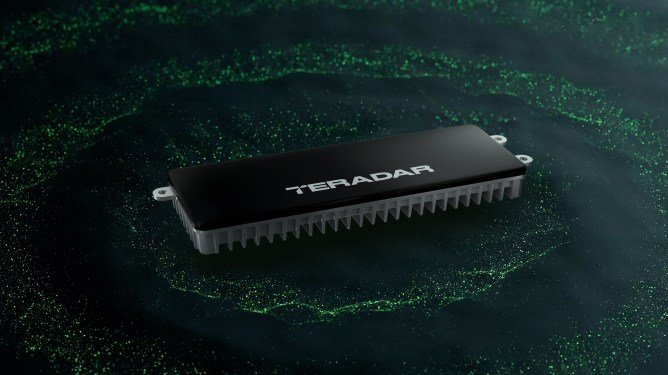
Two months after coming out of stealth with a $150 million fundraise, Boston-based Teradar is showing off its first flagship terahertz sensor at the Consumer Electronics Show 2026 this week. The company is positioning the sensor, called Summit, as the first long-range, high-resolution sensor of its kind 'designed for high performance in any type of weather, filling a critical gap left by legacy radar and lidar sensors.'
The sensor will start shipping in 2028 if Teradar can secure contracts with automakers. If successful, the company expects the Summit to enable automakers to add partial or even full autonomy features to their vehicles.
Teradar’s approach leverages the relatively-unused terahertz band of the electromagnetic spectrum between microwaves and infrared. The sensor is solid-state, with no moving parts, combining the best qualities of lidar and radar sensors while minimizing drawbacks.
This proposition appeals to automakers looking to avoid the high cost of lidars or the limitations of radars. Teradar is already working with five top automakers from the U.S. and Europe, as well as three Tier 1 suppliers, to validate its technology.
Teradar’s entry into the market comes at a crucial time for automotive sensor suppliers. Leading U.S. lidar company Luminar recently filed for bankruptcy protection after contracts with Volvo and Mercedes-Benz fell through due in part to low-cost competition from China.
Teradar is also looking beyond automotive, with recent funding including investment from Lockheed Martin’s venture arm and VXI Capital, a defense-focused fund led by the former CTO of the U.S. military’s Defense Innovation Unit.
Lidar remains relevant in the auto industry, as Rivian announced plans to integrate a roof-mounted lidar sensor in its upcoming R2 SUV. Teradar CEO Matt Carey is confident that their terahertz sensor can meet the demands of the market and is eager to capitalize on the opportunity.