ST. PAUL, Minn. (AP) — Molly Kelley was shocked to discover in June that someone she knew had used easily accessible 'nudification' technology to create highly realistic and sexually explicit videos and images of her, using family photos from social media.
'My initial shock turned to horror when I learned that the same person targeted about 80, 85 other women, most of whom live in Minnesota, some of whom I know personally, and all of them had connections in some way to the offender,' Kelley said.
Minnesota is considering a new approach to address deepfake pornography, with a bipartisan-supported bill targeting companies that operate websites and apps allowing users to upload a photo that is then transformed into explicit images or videos.
States and Congress are exploring ways to regulate artificial intelligence, with many already banning the dissemination of sexually explicit deepfakes or revenge porn, regardless of whether AI was used in their creation. The goal of the Minnesota legislation is to prevent the creation of such material before it spreads online.
Legal experts on AI caution that the proposal may face challenges on free speech grounds.
Why advocates say the bill is needed
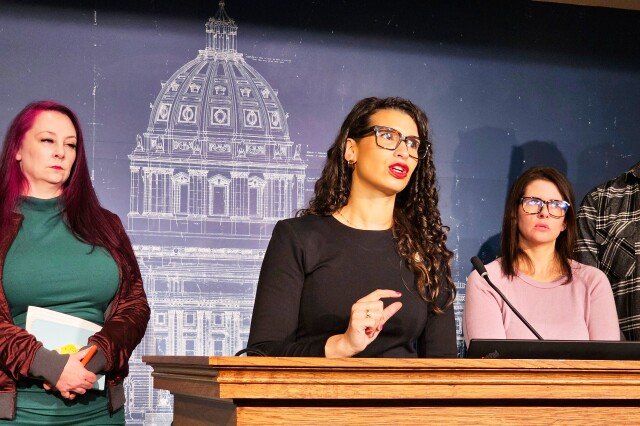
Lead author Democratic Sen. Erin Maye Quade explained that additional restrictions are needed due to rapid advancements in AI technology. The bill would require operators of 'nudification' sites and apps to prevent access by users in Minnesota or face civil penalties up to $500,000 for each unauthorized access, download, or use. Developers would need to disable the function for Minnesota users.
Maye Quade emphasized that the existence of these images is harmful to victims, not just their dissemination.
Kelley highlighted how quickly hyper-realistic images and videos can be created, with most law enforcement attention focusing on distribution and possession.
Congress, states and cities are also trying other tactics
In August, San Francisco filed a lawsuit against several 'nudification' websites, alleging violations of state laws against fraudulent practices, nonconsensual pornography, and child sexual abuse. The U.S. Senate passed a bill criminalizing nonconsensual sexual imagery, including AI-generated deepfakes, while Melania Trump advocated for its passage in the House. Similar bills have been introduced in several states.
Maye Quade plans to share the proposal with legislators in other states to raise awareness of the accessibility of such technology.
Victims tell their stories
Rainn's Sandi Johnson supported the Minnesota bill as a measure to hold websites accountable for the creation and dissemination of nonconsensual imagery. Megan Hurley shared her experience of being targeted by a 'nudification' site and expressed concern over the ease with which intimate imagery can be generated.
AI experts urge caution
AI law experts Wayne Unger and Riana Pfefferkorn raised concerns about the broad scope of the Minnesota bill and its potential challenges in court. Maye Quade defended the legislation, stating it regulates conduct, not speech, and is necessary to address the harm caused by such technology.
Contributions to this story were made by AP reporters Matt O'Brien, John Hanna, and Kate Payne.