OpenAI reports that its deep learning systems are making significant progress, with models becoming increasingly proficient at solving intricate tasks at a faster pace. CEO Sam Altman disclosed during a live stream on Tuesday that OpenAI is on track to achieve an intern-level research assistant by September 2026 and a fully automated 'legitimate AI researcher' by 2028.
The timeline set forth by OpenAI coincides with the organization's transition to a public benefit corporation structure, marking a departure from its prior non-profit status. This transformation eliminates constraints associated with the non-profit charter, while also creating opportunities for enhanced capital accumulation.
On the live stream, Jakub Pachocki, OpenAI's chief scientist, detailed the concept of an AI researcher, clarifying that it refers to a system capable of autonomously executing substantial research projects. Pachocki also expressed confidence that deep learning systems may be less than a decade away from achieving superintelligence, which denotes systems with superior intelligence compared to humans across various crucial activities.
To realize these objectives, OpenAI is focusing on two primary strategies: continued algorithmic innovation and a significant increase in 'test time compute,' which involves the duration models spend contemplating problems. Pachocki explained that current models can handle tasks within a five-hour time frame and match top human performers in competitions like the International Mathematical Olympiad. However, he anticipates this timeframe expanding rapidly by allocating additional computational resources to address complex issues. For major scientific breakthroughs, Pachocki suggested dedicating the computing power of entire data centers to a single problem.
OpenAI asserts that these initiatives align with the company's commitment to advancing scientific research and leveraging AI to expedite discoveries, tackle challenges beyond human capacity, and accelerate innovation in fields such as medicine, physics, and technology development.
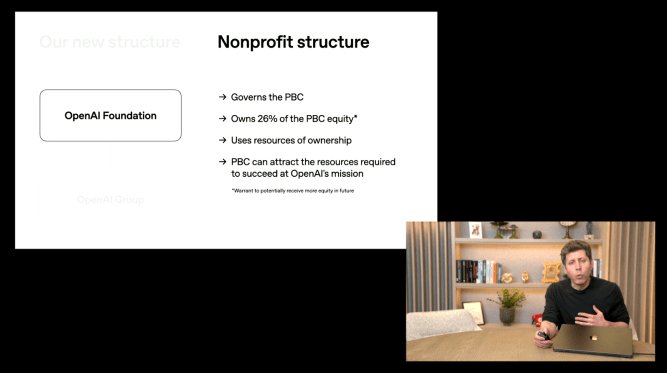
Altman highlighted that the restructuring not only supports OpenAI's ambitious AI research assistant timeline but also underscores the organization's dedication to responsible AI development. Under the new structure, the non-profit OpenAI Foundation, focused on scientific progress, will possess a 26% stake in the for-profit entity and lead research efforts. The non-profit has pledged $25 billion to leverage AI for curing diseases and will oversee AI research and safety initiatives.
Altman noted that the for-profit arm's increased fundraising capacity enables the scaling of infrastructure essential for scientific advancements. OpenAI has committed to developing 30 gigawatts of infrastructure, representing a financial obligation of $1.4 trillion over the coming years.