
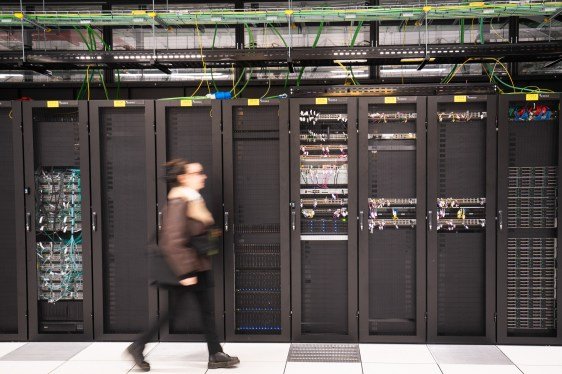
As technology companies announce plans for large new data centers, consumers are becoming increasingly concerned that the surge in AI-driven development will eventually lead to higher electricity prices, according to a recent survey.
The survey, commissioned by solar installer Sunrun, revealed that 80% of consumers are anxious about the impact of data centers on their utility bills.
These concerns are not unfounded. Electricity demand in the United States remained constant for over a decade, as reported by the U.S. Energy Information Administration (EIA). However, in the last five years, there has been an increase in demand from commercial users, including data centers and industrial users, with annual growth rates of 2.6% and 2.1%, respectively. In contrast, residential usage only grew by 0.7% annually.
Currently, data centers consume around 4% of the electricity generated in the United States, which is more than double their share in 2018. Projections indicate that by 2028, consumption could rise to between 6.7% and 12%, according to the Lawrence Berkeley National Laboratory.
To meet the growing demand, there has been a surge in new capacity from solar, wind, and grid-scale battery storage. Major tech companies are securing large agreements for new utility-scale solar projects, attracted by the low cost, modularity, and quick deployment of solar energy. Solar farms can start supplying power to data centers even before their completion, with a typical project taking around 18 months to finish.
The EIA anticipates that renewables will continue to dominate new electricity generation capacity through at least the following year. However, experts predict that the repeal of key portions of the Inflation Reduction Act by Republicans could hinder the growth of renewables.
On the other hand, natural gas, another favored energy source for data centers, has not kept pace with the demand. Despite rising production, most of the new supplies have been directed towards exports rather than the domestic market. Between 2019 and 2024, consumption by electricity generators increased by 20%, while exports grew by 140%.
New natural gas power plants will not be operational in time to address the current energy needs, as they typically take around four years to complete, according to the International Energy Agency. Additionally, a backlog of turbines used by gas-fired power plants has exacerbated the issue, with manufacturers quoting delivery dates up to seven years out.
The slow progress of natural gas developments, coupled with challenges in the renewable energy sector, has presented a dilemma for data center developers.
Although AI and data centers are not solely responsible for the surge in electricity demand — industrial users have also played a significant role — they have been prominently featured in the news. AI, in particular, is likely to attract consumer scrutiny, as more people are worried about the technology than excited about it, as indicated by a Pew survey. This sentiment is understandable, given that many employers have utilized AI as a means to reduce workforce numbers rather than enhance employee productivity.
With the combination of rising energy prices, it is clear that a potential backlash could be on the horizon.


